
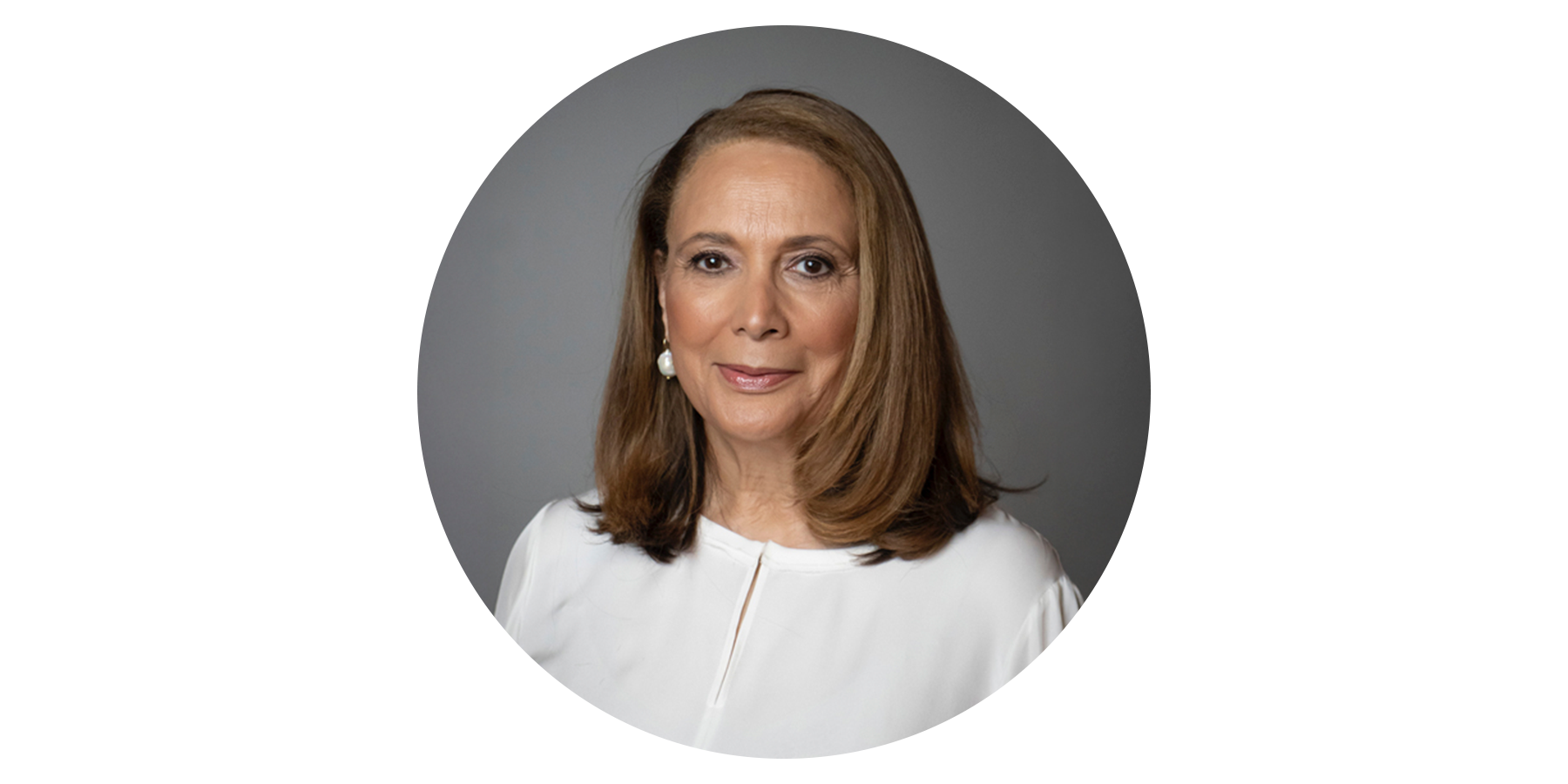
Who gets a seat at the table? At the movie theater? At the school desk? These were questions that Miriam Brown Hutchins ’73 saw answered throughout her childhood in Baltimore. She remembers when her dad took her to see West Side Story, and they were told they couldn’t enter the theater. She remembers when she switched from an all-Black Catholic school in East Baltimore to a predominately white one, where the nuns told her repeatedly there was no place for her, until eventually two of the nuns told her there was.
“Having access, having choices in education, desegregation—those are the kinds of things that made an impression upon me as a child,” says Hutchins. “It would have been difficult to not get involved and to not care about the direction our society was taking.”
As a child in the 1960s, Hutchins witnessed the first African American judges appointed to the bench in Baltimore City. After Goucher, Hutchins attended Georgetown University Law Center, then went to Ithaca, NY, to work as a law clerk for Judge Betty Friedlander, who was also a Goucher alumna, Class of 1945. “She was the first woman judge in Tompkins County,” says Hutchins. “And she set an example for me for public service.”
Who gets to argue before a judge? Who gets to be a judge? Hutchins saw that the answer could be her.
Hutchins went on to work in the New York attorney general’s office, defending the state in courthouses around the Finger Lakes. She was also in charge of consumer fraud and protection cases. “Working in the public sector was a great opportunity and great exposure for me,” she says.
Hutchins and her husband and children eventually moved back to Baltimore, where in 1988 she became assistant city solicitor. In 1990, she also took on the role of domestic equity master for the circuit court of Baltimore City, which meant she heard matters of temporary custody, visitation, child support, and alimony. “I would interview children sometimes to find out how they felt about where they were living and their relationships with their parents in order to make a decision about custody and visitation,” she says. “Especially with older children, you wanted to know what they thought and how they felt, so it could be something that actually worked.”
In 2000, Hutchins was appointed associate judge to the District Court of Maryland in Baltimore City, where she worked until her retirement in 2016. As a judge, Hutchins found that showing respect for people was always the best way to reach them. “Sometimes you have to let people know that what they had done is horrible,” she says, “but there’s a way to do it that also shows respect for their humanity and the possibility that they can do better.”
Throughout her career, Hutchins continued to advocate for children. She was an advisory board member for the Girls Empowerment Mission for three years, and she has been involved with a University of Baltimore program called the Tackling Chronic Absenteeism Project (TCAP) for many years. The project brings judges to schools every week to talk to students about the harm of missing class. “It is an extremely challenging job because these kids have so many struggles to overcome,” says Hutchins. “It’s humbling, because I never had to worry about not having breakfast or helping a sibling get to school.” Hutchins doesn’t lecture the kids; instead, she asks them questions and talks to them about strategies for getting enough sleep and improving their performance in school.
In 2023, the University of Baltimore awarded Hutchins for her work with TCAP, noting her special ability to draw children out of their shells. “A lot of these kids have the ability to figure out things for themselves with a little help. I talk to them and try to draw out their ideas and what they feel would work for them,” she says. “I really believe in empowering them to make decisions and solve problems.”
Hutchins has also been deeply involved with Goucher over the years, both as a member of the Board of Trustees and as a supporter of the Imani Fund, which helps first-generation college students afford study abroad experiences. She’s also been integral to the Jewell Robinson Dinner, at which the Barland Award is given out. “It has grown so much,” says Hutchins. “The event has expanded in terms of the number of people attending, has grown in terms of the Barland Award, has grown in terms of including performances by Goucher students. It’s become one of the premier events that Goucher has.”
This February will be the 20th anniversary of the dinner. “It’s a chance for the students who come to see what they can become. It’s a chance for alumni to catch up with each other but also provide that support that we need in the professional world,” she says. “Most importantly, it’s a chance to give back. There’s just an energy there that is inspiring, invigorating, and really beautiful.”
There is so much more that Hutchins has done, and continues to do, for so many communities. She has worked with the Baltimore chapter of the Links, which provides scholarships and health programs to African American communities. Hutchins is vice chair for the board of Baltimore Behavioral Health Systems, a nonprofit that manages city programs that deal with mental health and addiction. And she’s on the board of INSeries Opera in DC, helping them increase their presence in Baltimore.
Why does she do what she does? Ever since she was a little girl in Baltimore, Miriam Hutchins watched her parents balance life and responsibility to her, to other family, to the community, and to their professional careers. “They were my first inspiration,” she says. “And they made it seem effortless. I now know that it required a lot of hard work, and sacrifice, and determination.”